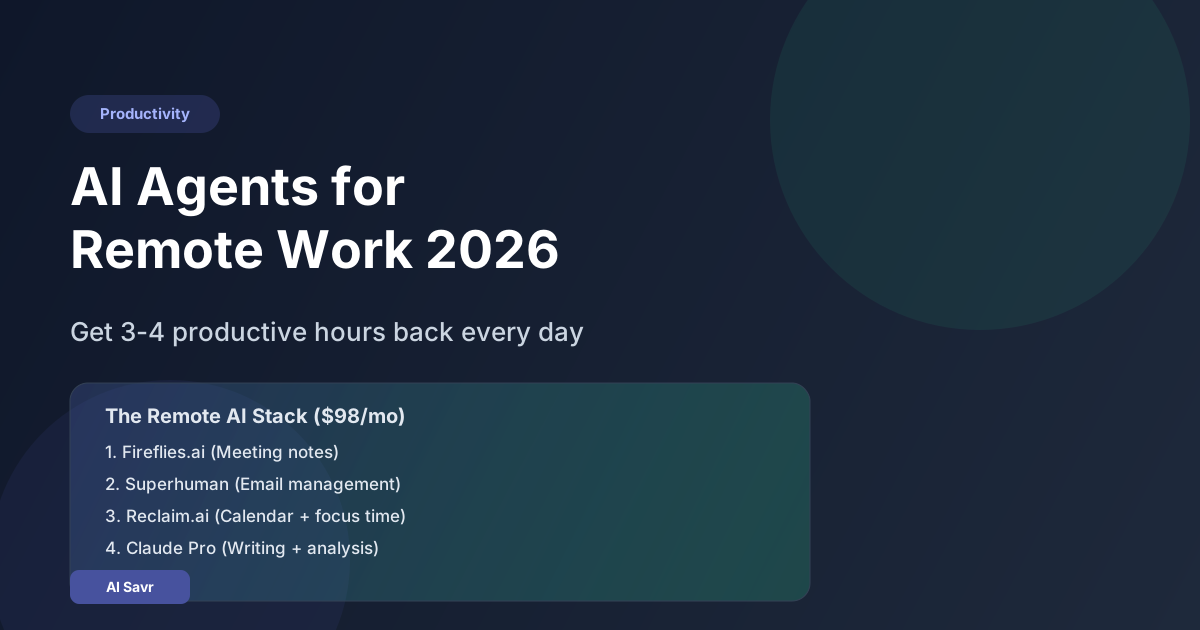
Remote work was supposed to give us freedom. Instead, most remote workers spend their day in meetings, answering Slack messages, writing status updates, and doing admin work that has nothing to do with their actual job.
AI agents are finally fixing this. The remote workers who adopted AI agents in early 2026 report getting 3-4 productive hours back per day. Not by working faster, but by delegating the busywork to AI.
Here is the exact setup that works.
The Remote Work Time Drain
Before fixing the problem, look at where a typical remote worker's day actually goes:
| Activity | Hours/Day | Can AI Handle It? |
|---|---|---|
| Meetings | 2.5 | Partially (notes, follow-ups) |
| Email and Slack | 2.0 | Mostly |
| Status updates and reports | 1.0 | Completely |
| Scheduling and coordination | 0.5 | Completely |
| Research and information gathering | 1.0 | Mostly |
| Deep work (actual job) | 3.0 | This is what you should be doing more |
That means only 3 out of 8 hours are spent on meaningful work. AI agents can reclaim 3-4 hours from the other categories.
The AI Agent Stack for Remote Workers
Meeting Agent: Fireflies.ai or Otter.ai
These AI agents join your video calls automatically, transcribe everything, identify action items, and send summaries to all participants.
What changes: You can skip meetings you do not really need to attend. Read the 2-minute summary instead. For meetings you do attend, you never take notes again.
Setup: Connect Fireflies.ai to your Google Calendar. It auto-joins every meeting and emails you a summary with action items within 5 minutes of the call ending.
Cost: $18/month (Pro plan)
Email Agent: Superhuman AI or Gmail + ChatGPT
AI email agents draft replies, categorize your inbox, and surface the messages that actually need your attention.
What changes: Instead of spending 45 minutes on email each morning, you spend 10 minutes reviewing AI-drafted replies and hitting send.
Setup: Superhuman has AI drafting built in. For Gmail users, the built-in Gemini integration handles basic drafting. For more control, use a browser extension like Compose AI.
Cost: Superhuman at $30/month, Gmail Gemini is free
Slack/Teams Agent: AI Summary Bots
Tools like Reclaim.ai and Slack's built-in AI can summarize channels, highlight important messages, and draft responses.
What changes: Instead of reading 200 Slack messages when you get back from a break, you get a 30-second summary of what happened and what needs your attention.
Cost: Slack AI is included in paid plans, Reclaim.ai from $10/month
Writing Agent: Claude or ChatGPT
For drafting documents, proposals, reports, and presentations.
What changes: First drafts that used to take 2 hours now take 20 minutes. You focus on editing and adding your expertise instead of staring at a blank page.
Cost: $20/month for ChatGPT Plus or Claude Pro
Research Agent: Perplexity or Manus AI
When you need to research a topic, analyze competitors, or gather data for a decision.
What changes: Research that took half a day now takes 15 minutes. The AI agent searches, compiles, and organizes the information. You verify and apply it.
Cost: Perplexity Pro at $20/month, Manus AI from $39/month
Scheduling Agent: Reclaim.ai
This AI agent manages your calendar, blocks focus time, schedules meetings around your preferences, and defends your deep work hours.
What changes: No more calendar Tetris. The AI optimizes your week so you have long blocks of uninterrupted focus time.
Cost: $10/month
The Total Stack Cost
| Agent | Purpose | Monthly Cost |
|---|---|---|
| Fireflies.ai | Meeting notes | $18 |
| Superhuman | Email management | $30 |
| Reclaim.ai | Calendar + Slack | $10 |
| Claude Pro | Writing and analysis | $20 |
| Perplexity Pro | Research | $20 |
| Total | $98/month |
For $98/month, you get 3-4 hours of productive time back per day. If your hourly value is $50+, the ROI is obvious.
The Weekly Workflow With AI Agents
Monday Morning (30 minutes instead of 2 hours)
- Reclaim.ai has already organized your week with focus blocks
- Fireflies.ai summaries from any Friday meetings you missed are in your inbox
- Review Slack AI summary of weekend messages
- Scan email with Superhuman AI, approve or edit drafted replies
- Start your first deep work block by 9:30 AM
During the Week
- AI joins all your meetings, you only attend the ones where you need to be present
- Status updates generate automatically from your completed tasks and meeting summaries
- Research requests go to Perplexity. Results in 5 minutes, not 2 hours
- Document drafts start with Claude. You add your expertise and edit
Friday Afternoon (15 minutes instead of 1 hour)
- AI generates your weekly summary from meeting notes and completed tasks
- Scheduling agent blocks your Monday morning focus time
- Email agent drafts any end-of-week follow-ups
What AI Agents Cannot Do for Remote Work
Let's be honest about the limitations:
- Build relationships: AI cannot replace genuine human connection. Make time for 1-on-1 video calls with teammates
- Navigate office politics: Understanding team dynamics and organizational nuance requires human judgment
- Creative problem solving: AI is great at executing but weak at the kind of creative thinking that comes from brainstorming with colleagues
- Provide emotional support: Being a good remote colleague means checking in on people. This should never be automated
- Make judgment calls: When a decision could go either way, you need human experience and intuition
Tips for Getting Started
- Start with one agent: Pick the biggest time drain (usually meetings or email) and automate that first
- Give it two weeks: The first week feels weird. By week two, you can not imagine going back
- Tell your team: Let colleagues know you are using AI for meeting summaries and email drafts. Transparency builds trust
- Review before sending: Always review AI-drafted communications before they go out. Your reputation is on the line, not the AI's
- Protect your saved time: Use the reclaimed hours for deep work, not more meetings
The Bottom Line
Remote work + AI agents is the most productive combination in the history of knowledge work. For under $100/month, you can automate the busywork that steals your best hours and focus on the work that actually moves the needle.
The remote workers who figure this out in 2026 will outperform their peers so dramatically that AI agent adoption will become as standard as having a laptop.