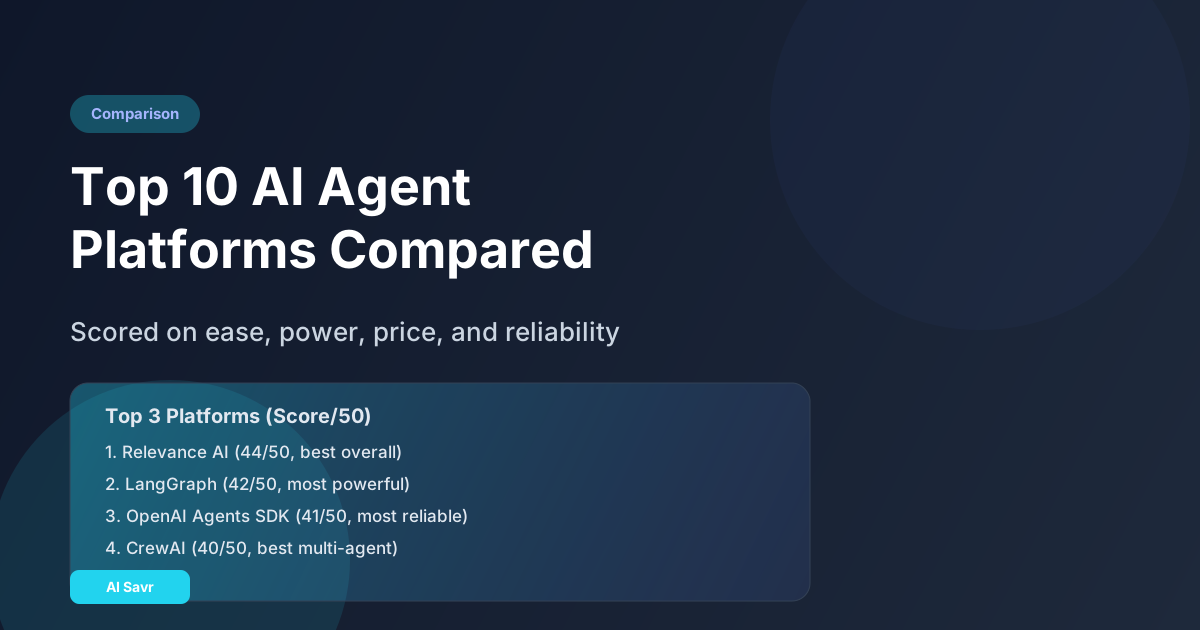
The AI agent platform market exploded in 2026. There are now over 50 platforms claiming to let you build and deploy AI agents. Most are not worth your time.
We tested the top 10 platforms on real tasks, scored them across five categories, and created this comparison guide so you can pick the right one without wasting weeks on trials.
How We Tested
Each platform was tested on the same three tasks:
- Research task: Find and summarize the latest funding rounds in the AI industry
- Automation task: Monitor a Google Sheet and send email notifications when values change
- Customer interaction task: Build a FAQ bot that can answer questions about a product
We scored each platform on:
- Ease of use (1-10): How quickly can a non-developer get started?
- Power (1-10): How complex can the agents get?
- Pricing (1-10): Value for money
- Reliability (1-10): Did things break during testing?
- Support (1-10): Documentation quality and customer support
The Rankings
1. Relevance AI (Score: 44/50)
| Category | Score |
|---|---|
| Ease of use | 8 |
| Power | 9 |
| Pricing | 9 |
| Reliability | 9 |
| Support | 9 |
Relevance AI is the most well-rounded platform. The visual agent builder is intuitive, the tool library is extensive, and the free tier is generous enough to build real agents.
Strengths: Clean interface, powerful tool system, great templates, active community Weaknesses: Learning curve for advanced features, some tools require API keys Best for: Business professionals who want powerful agents without code Pricing: Free tier, Pro from $49/month
2. LangGraph / LangChain (Score: 42/50)
| Category | Score |
|---|---|
| Ease of use | 6 |
| Power | 10 |
| Pricing | 9 |
| Reliability | 9 |
| Support | 8 |
The gold standard for developers building production-grade agents. LangGraph handles state management, streaming, and complex multi-agent architectures better than anything else.
Strengths: Maximum flexibility, state management, production-ready, excellent docs Weaknesses: Requires Python/JavaScript knowledge, steep learning curve Best for: Developers building custom agent applications Pricing: Free (open source), LangSmith monitoring from $39/month
3. OpenAI Agents SDK (Score: 41/50)
| Category | Score |
|---|---|
| Ease of use | 7 |
| Power | 9 |
| Pricing | 8 |
| Reliability | 9 |
| Support | 8 |
OpenAI's official agent framework. Clean API, excellent documentation, and the reliability of GPT-5 behind it. The best choice if you are already in the OpenAI ecosystem.
Strengths: Clean API design, great docs, reliable models, built-in tracing Weaknesses: Locked to OpenAI models, API costs can add up Best for: Teams already using OpenAI products Pricing: API usage based
4. CrewAI (Score: 40/50)
| Category | Score |
|---|---|
| Ease of use | 7 |
| Power | 9 |
| Pricing | 9 |
| Reliability | 8 |
| Support | 7 |
CrewAI makes multi-agent collaboration simple. Define agents with roles, give them tasks, and let them work together. The role-based metaphor is brilliant and easy to understand.
Strengths: Intuitive role-based model, multi-agent coordination, Python-based Weaknesses: Documentation could be better, some edge cases with agent coordination Best for: Content teams, research workflows, any task needing multiple AI perspectives Pricing: Free (open source), Enterprise plans available
5. Zapier Central (Score: 39/50)
| Category | Score |
|---|---|
| Ease of use | 9 |
| Power | 7 |
| Pricing | 8 |
| Reliability | 8 |
| Support | 7 |
Zapier's AI agent layer sits on top of their 6,000+ app integrations. If you already use Zapier, adding AI agents to your workflows is a natural evolution.
Strengths: Massive integration library, familiar interface, easy setup Weaknesses: Less powerful for complex agent logic, costs scale with usage Best for: Teams that want AI-enhanced automation across existing tools Pricing: From $29/month
6. Voiceflow (Score: 38/50)
| Category | Score |
|---|---|
| Ease of use | 8 |
| Power | 8 |
| Pricing | 7 |
| Reliability | 8 |
| Support | 7 |
The best platform for building conversational AI agents. The visual builder makes it easy to design complex conversation flows with RAG, API calls, and conditional logic.
Strengths: Visual conversation design, RAG integration, multi-channel deployment Weaknesses: Focused on conversational agents (not general purpose) Best for: Customer-facing chatbots and voice agents Pricing: Free tier, Pro from $50/month
7. Stack AI (Score: 37/50)
| Category | Score |
|---|---|
| Ease of use | 8 |
| Power | 7 |
| Pricing | 8 |
| Reliability | 7 |
| Support | 7 |
Clean, visual workflow builder for AI agents. Great for document processing, data extraction, and structured workflows. The drag-and-drop interface is one of the best.
Strengths: Clean UI, good for document processing, easy API deployment Weaknesses: Fewer integrations than competitors, newer platform Best for: Document-heavy workflows, structured data processing Pricing: Free tier, Pro from $49/month
8. n8n (Score: 36/50)
| Category | Score |
|---|---|
| Ease of use | 6 |
| Power | 8 |
| Pricing | 10 |
| Reliability | 7 |
| Support | 5 |
Self-hostable workflow automation with solid AI nodes. More technical than Zapier but significantly cheaper at scale and you own your data.
Strengths: Self-hosted option, great value, powerful AI nodes, no vendor lock-in Weaknesses: Steeper learning curve, community support only on free plan Best for: Technical teams who want full control over their agent infrastructure Pricing: Free (self-hosted), Cloud from $24/month
9. AutoGen (Microsoft) (Score: 35/50)
| Category | Score |
|---|---|
| Ease of use | 5 |
| Power | 9 |
| Pricing | 8 |
| Reliability | 7 |
| Support | 6 |
Microsoft's multi-agent framework. Strong on agent-to-agent conversation and group chat patterns. Good for complex reasoning tasks that benefit from multiple AI perspectives.
Strengths: Multi-agent conversations, Microsoft backing, complex reasoning support Weaknesses: Difficult to set up, documentation needs improvement Best for: Research teams, complex reasoning tasks, enterprise applications Pricing: Free (open source), Azure costs for hosting
10. Botpress (Score: 34/50)
| Category | Score |
|---|---|
| Ease of use | 7 |
| Power | 7 |
| Pricing | 7 |
| Reliability | 7 |
| Support | 6 |
Established chatbot platform that has evolved into a decent AI agent builder. Good for customer service bots and knowledge base agents.
Strengths: Mature platform, good analytics, multi-channel support Weaknesses: UI feels dated compared to newer platforms, complex pricing Best for: Customer service teams already using chatbot platforms Pricing: Free tier, Plus from $79/month
Quick Decision Guide
I want the easiest setup: Zapier Central or Relevance AI I want maximum power (and I can code): LangGraph or OpenAI Agents SDK I want multi-agent teams: CrewAI or AutoGen I want a customer-facing chatbot: Voiceflow or Botpress I want to own my data: n8n (self-hosted) or LangGraph I have the lowest budget: n8n (free self-hosted) or CrewAI (free)
What to Watch For in 2026-2027
- Consolidation: Expect acquisitions. Smaller platforms will get bought by larger ones
- Standardization: Agent communication protocols are emerging. Platforms that support them will win
- Specialization: General-purpose platforms will struggle against industry-specific agents
- Integration depth: The platforms with the deepest tool integrations will attract the most users
- Enterprise features: SSO, audit logs, compliance certifications will become table stakes
The Bottom Line
There is no single "best" platform. The right one depends on your technical level, use case, and budget.
If you are non-technical, start with Relevance AI or Zapier Central. If you can code, go with LangGraph or OpenAI Agents SDK. If you need customer-facing bots, Voiceflow is the clear choice.
The most important thing is to start building. Pick a platform, build one agent, and see the results. You can always switch later.