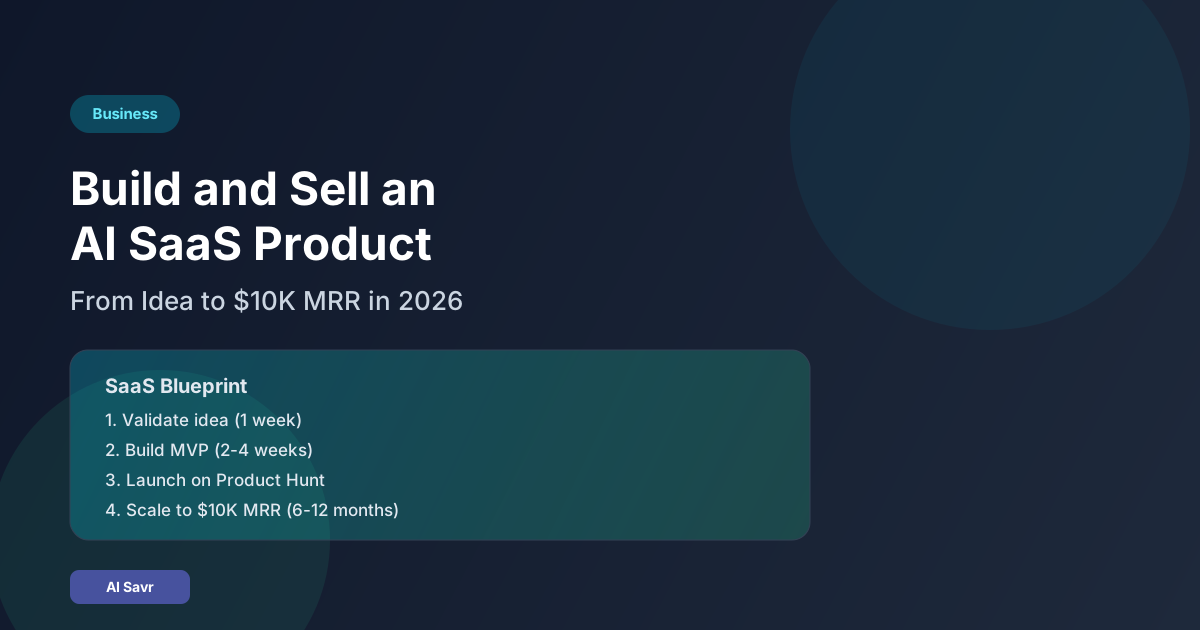
You do not need to be a Silicon Valley engineer to build an AI SaaS product. In 2026, the combination of powerful AI APIs and no-code/low-code tools means a single person can build, launch, and scale a profitable software product.
Some call them "AI wrappers." Smart founders call them businesses. The ones solving real problems are earning $5,000 to $100,000 per month in recurring revenue.
Here is how to go from idea to $10,000 MRR (Monthly Recurring Revenue).
Why AI SaaS Is the Best Business Model in 2026
Recurring revenue: Customers pay monthly, creating predictable income. High margins: Software costs nearly nothing to replicate. Your main costs are AI API usage and hosting. Scalable: Serve 10 or 10,000 customers with the same product. Low startup cost: $0 to $500/month to build and run using no-code tools and APIs. AI does the heavy lifting: The AI APIs from OpenAI, Anthropic, and Google handle the complex intelligence. You handle the user experience and workflow.
15 AI SaaS Ideas That Work in 2026
Quick Wins (Can be built in a weekend)
- AI Resume Optimizer - Paste a job description and resume, get optimized version ($10 to $30/month)
- AI Social Media Post Generator - Generate a week of posts for any business ($15 to $50/month)
- AI Meeting Notes Summarizer - Upload meeting recordings, get structured notes ($10 to $25/month)
- AI Product Description Writer - For e-commerce stores, generate descriptions from product photos ($20 to $50/month)
- AI Email Subject Line Tester - Generate and A/B test subject lines with AI ($15 to $40/month)
Medium Complexity (1 to 4 weeks to build)
- AI Customer Support Assistant - Train on company docs, answer customer questions ($50 to $200/month)
- AI SEO Content Optimizer - Analyze and optimize existing content for search ($30 to $100/month)
- AI Competitor Monitor - Track and analyze competitor changes with AI ($50 to $150/month)
- AI Invoice Data Extractor - Upload invoices, get structured data ($30 to $100/month)
- AI Content Calendar Planner - Generate a month of content ideas with AI research ($20 to $60/month)
Higher Complexity, Higher Value (1 to 3 months to build)
- AI-Powered CRM - Automatic lead scoring, email drafting, and follow-up scheduling ($50 to $200/month)
- AI Legal Document Analyzer - Upload contracts, get key terms and risk analysis ($100 to $500/month)
- AI Financial Report Generator - Connect accounting data, generate narrative reports ($100 to $300/month)
- AI Hiring Assistant - Screen resumes, generate interview questions, assess candidates ($100 to $400/month)
- AI Course Creator - Turn any document or expertise into a structured course ($50 to $150/month)
Validating Your Idea Before Building
Do not build anything until you validate demand. Here is how:
Step 1: Problem Research (2 to 3 days)
- Search Reddit, Twitter/X, and LinkedIn for people complaining about the problem you want to solve
- Look at existing solutions. Are they expensive, outdated, or missing key features?
- Check Google Trends for related search terms
- Search Product Hunt for similar products and read the comments
Step 2: Competitor Analysis (1 day)
- List every existing tool that solves a similar problem
- Note their pricing, features, and customer reviews
- Identify gaps: what do customers complain about? What features are missing?
- Find your angle: faster, cheaper, simpler, better for a specific niche?
Step 3: Pre-Sell (1 week)
The ultimate validation is getting people to pay before you build.
- Create a simple landing page describing your product
- Add a "Join waitlist" or "Pre-order at 50% off" button
- Drive traffic through social media posts, Reddit, and direct outreach
- If 50+ people join your waitlist or 5+ people pre-pay, you have validation
Building Your AI SaaS: The Tech Stack
For Non-Technical Founders (No Code)
| Layer | Tool | Cost |
|---|---|---|
| Frontend | Bubble or Softr | $29 to $89/month |
| Backend logic | Make or Zapier | $9 to $100/month |
| AI integration | OpenAI API or Claude API | Pay per use ($5 to $100/month) |
| Database | Airtable or Supabase | Free to $20/month |
| Authentication | Built into Bubble/Softr | Included |
| Payments | Stripe | 2.9% + $0.30 per transaction |
| Hosting | Included with platform | Included |
Total: $50 to $200/month
For Technical Founders (Code)
| Layer | Tool | Cost |
|---|---|---|
| Frontend | Next.js or React | Free |
| Backend | Node.js, Python, or Next.js API routes | Free |
| AI integration | OpenAI API, Anthropic API | Pay per use |
| Database | Supabase or PlanetScale | Free tier |
| Authentication | Clerk or NextAuth | Free tier |
| Payments | Stripe | 2.9% + $0.30 |
| Hosting | Vercel or Railway | Free to $20/month |
Total: $0 to $50/month (plus API usage)
AI-Assisted Development
Use AI coding tools to build faster:
- Cursor - AI-powered code editor that writes code from natural language
- GitHub Copilot - Code completion and generation in VS Code
- v0 by Vercel - Generate React components from descriptions
- Claude/ChatGPT - Debug code, explain concepts, write functions
A technical founder using AI tools can build an MVP in 1 to 2 weeks. A non-technical founder using no-code tools can build one in 2 to 4 weeks.
Building Your MVP (Minimum Viable Product)
The 80/20 Rule
Your MVP should do ONE thing exceptionally well. Not ten things poorly.
What to include:
- Core feature that solves the main problem
- User authentication (sign up, log in)
- Payment processing (Stripe)
- Basic dashboard for users
- Simple onboarding flow
What to skip for now:
- Team features and collaboration
- Advanced analytics
- Mobile app
- API access
- Custom integrations
- Admin dashboard (use your database directly)
Managing AI API Costs
AI API costs can kill your margins if you are not careful.
Cost optimization strategies:
- Use GPT-3.5 Turbo or Claude Haiku for simple tasks ($0.0005 per query vs $0.03 for GPT-4)
- Cache common AI responses to avoid redundant API calls
- Set usage limits per user per plan
- Use shorter prompts (tokens cost money)
- Batch requests when possible
- Monitor usage daily and set spending alerts
Typical AI API cost per user: $0.50 to $5/month depending on usage intensity. If you charge $30/month and spend $2/month on AI per user, your margins are excellent.
Pricing Your AI SaaS
The Three-Tier Model
| Starter | Pro | Business | |
|---|---|---|---|
| Price | $15 to $29/month | $39 to $79/month | $99 to $199/month |
| Usage limits | 50 to 100 uses/month | 200 to 500 uses/month | Unlimited |
| Features | Core features only | All features | All features plus priority support |
| Users | 1 user | Up to 5 users | Unlimited users |
| Support | Email only | Email plus chat | Priority support |
Pricing Psychology
- Always offer annual plans with a 20% to 30% discount (improves cash flow and reduces churn)
- Include a free trial (7 to 14 days, no credit card required)
- Show the "most popular" badge on your middle tier
- Price based on value delivered, not AI API cost
Launching Your Product
Pre-Launch Checklist
- Landing page with clear value proposition
- Demo video (under 2 minutes)
- 3 to 5 testimonials from beta users
- Pricing page
- Terms of service and privacy policy
- Customer support channel (email or chat)
Launch Channels
Product Hunt: The most important single launch day for SaaS products. Prepare 2 weeks in advance with a hunter, compelling copy, and a team ready to engage with comments.
Hacker News (Show HN): Technical audience, great for feedback and early adopters.
Reddit: Post in relevant subreddits (not spammy, provide genuine value).
Twitter/X: Thread about the problem you solve and how you built the product.
LinkedIn: Post about the business problem and your solution. Tag relevant people.
Indie Hackers: Perfect community for sharing your journey and getting feedback.
The First 100 Users Strategy
Getting to 100 paying users is the hardest milestone. Here is the playbook:
Weeks 1 to 2: Personal outreach. Message 100 people who fit your target audience. Offer extended free trials or lifetime deals for early adopters.
Weeks 3 to 4: Content marketing. Write 5 to 10 blog posts targeting keywords your audience searches for. Share on social media.
Months 2 to 3: Referral program. Give existing users a reason to refer others (free months, feature upgrades).
Months 3 to 6: SEO and paid ads. Your blog posts start ranking. Run small ad experiments ($10 to $20/day) on Google or Facebook.
Growing to $10K MRR
The Math
$10K MRR at $50/month average = 200 paying customers.
200 customers over 6 to 12 months = acquiring 4 to 8 new customers per week, consistently.
That is achievable with a combination of:
- Organic search traffic (30% of customers)
- Social media and content marketing (25%)
- Word of mouth and referrals (25%)
- Paid advertising (20%)
Reducing Churn
Keeping customers is cheaper than acquiring new ones. Target less than 5% monthly churn.
Churn reduction strategies:
- Onboarding emails that show users how to get value fast
- In-app usage prompts and tips
- Monthly product updates and improvements
- Responsive customer support (reply within 4 hours)
- Annual plan incentives (locked-in customers churn less)
- Regular feature releases based on customer feedback
Key Metrics to Track
| Metric | Target |
|---|---|
| Monthly Recurring Revenue (MRR) | Growing 10% to 20% month-over-month |
| Churn rate | Under 5% monthly |
| Customer Acquisition Cost (CAC) | Under 3x monthly plan price |
| Lifetime Value (LTV) | 10x or more of CAC |
| Net Promoter Score (NPS) | Above 40 |
| Activation rate | Above 60% (users who complete onboarding) |
Common AI SaaS Mistakes
Mistake 1: Building a "GPT Wrapper" With No Unique Value
Putting a pretty interface on the ChatGPT API is not a product. Your value must come from workflow, data, integration, or domain expertise that a user cannot replicate by talking to ChatGPT directly.
Mistake 2: Ignoring Unit Economics
If you spend $5 on AI per user and charge $10/month, your margins are terrible after hosting, support, and marketing costs. Know your costs per user before setting prices.
Mistake 3: Building Too Many Features
Feature creep kills startups. Launch with one core feature. Add more only when users request them repeatedly.
Mistake 4: Underinvesting in Onboarding
If users do not experience value in their first session, they will never come back. Build an onboarding flow that gets them to their "aha moment" in under 5 minutes.
Mistake 5: No Distribution Strategy
"Build it and they will come" is a fantasy. Plan your distribution strategy before writing a single line of code.
The Bottom Line
Building an AI SaaS product is more accessible in 2026 than building a traditional software product has ever been. The AI APIs handle the intelligence, no-code tools handle the infrastructure, and your job is to find a real problem, build a clean solution, and market it effectively.
Start with a simple idea. Validate it in a week. Build an MVP in a month. Get to 10 paying customers as fast as possible. Then iterate.
The founders who ship fast and listen to customers are the ones who reach $10K MRR. The ones who spend 6 months perfecting their product in isolation usually fail.
Browse our AI tools directory for inspiration on AI products people actually use, and check our best AI tools lists for market research on successful products.