Let's skip the usual "AI will create more jobs than it destroys" platitude and look at what's actually happening in 2026.
Some jobs are genuinely disappearing. Others are transforming. And some new ones didn't exist two years ago. Here's an honest assessment.
Jobs AI is Already Replacing
Data Entry and Basic Admin
This one's been happening for years, but AI accelerated it. Tools like Zapier AI, Make, and n8n handle data entry, form filling, and basic administrative tasks that used to require full-time employees.
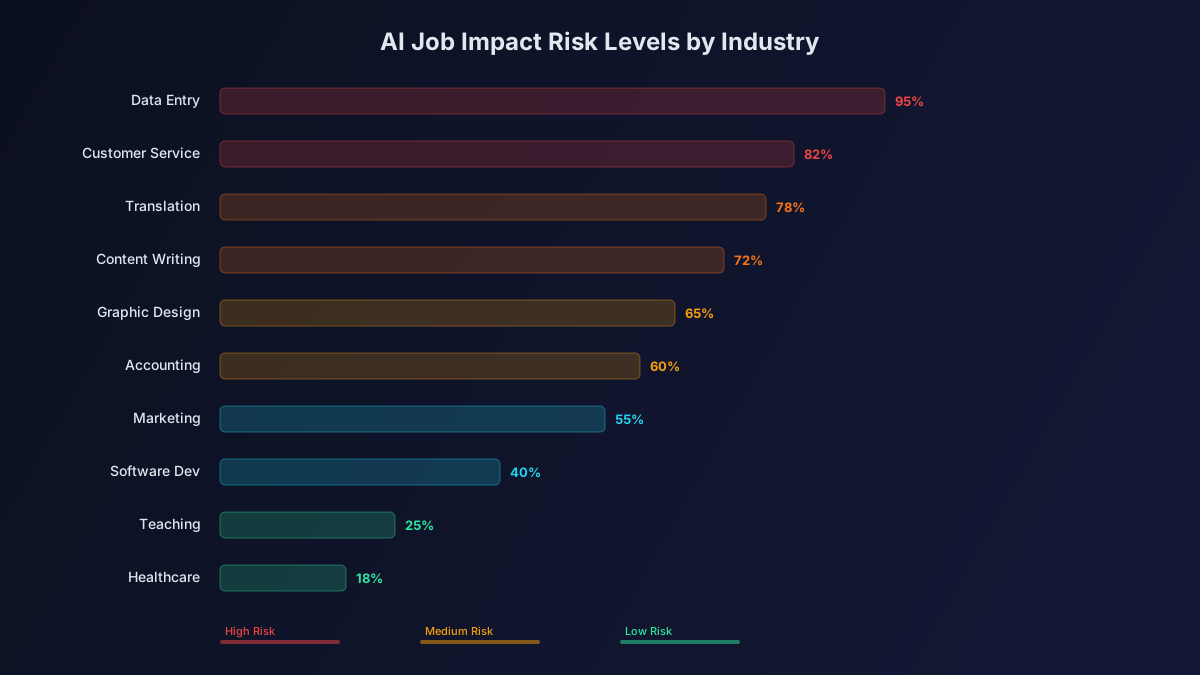
Impact level: High. Most large companies have already automated routine data entry.
Basic Content Writing
SEO blog posts, product descriptions, social media captions, and basic marketing copy. AI tools produce these faster and cheaper than entry-level writers.
Impact level: Medium-High. The demand for quality writers is stable, but commodity content writing has collapsed.
Customer Support (Tier 1)
AI chatbots handle most basic customer inquiries now. They answer FAQs, process returns, check order status, and resolve common issues without human intervention.
Impact level: High for tier-1 support. Complex customer issues still need humans.
Basic Graphic Design
Simple designs, social media templates, background removal, image resizing. Canva AI and similar tools have eliminated the need for designers on routine tasks.
Impact level: Medium. Creative design is safe, but production design is shrinking.
Translation (Basic)
AI translation is now good enough for most business communications. Human translators are still needed for nuanced, creative, and legal translations.
Impact level: High for basic translation. Specialized translation remains valuable.
Jobs Being Transformed (Not Replaced)
Software Development
AI hasn't replaced developers, but it's changed the job. The baseline skill requirement has dropped (anyone can prompt an app into existence) while the ceiling has risen (senior developers with AI are extraordinarily productive).
What to do: Learn to use AI coding tools. Focus on architecture, system design, and problem-solving. Those skills become more valuable, not less.
Marketing
AI handles content creation, data analysis, and campaign optimization. Marketers who use AI tools are doing the work of entire teams.
What to do: Master AI marketing tools. Focus on strategy, brand building, and human connection. Leave the execution to AI.
Finance and Accounting
AI automates bookkeeping, basic analysis, and report generation. Complex financial strategy, relationship management, and judgment calls remain human.
What to do: Move beyond routine analysis. Focus on strategic advisory, complex financial planning, and client relationships.
Legal
AI analyzes contracts, conducts legal research, and drafts basic documents. Courtroom advocacy, negotiation, and complex legal strategy remain human territories.
What to do: Use AI for research and document review. Focus on client advocacy, courtroom skills, and strategic counsel.
New Jobs AI Has Created
AI Prompt Engineers
Companies hire people who know how to get the best results from AI systems. This role bridges the gap between business needs and AI capabilities.
AI Implementation Consultants
Businesses need help choosing, implementing, and optimizing AI tools. This consulting niche is booming.
AI Ethics and Safety Officers
As AI use expands, companies need people to manage risks, ensure compliance, and maintain ethical standards.
AI Content Strategists
People who understand how AI changes content creation and can build strategies that combine human creativity with AI efficiency.
AI Trainers and Fine-Tuners
Specialists who fine-tune AI models for specific business needs, create custom datasets, and optimize AI performance.
How to AI-Proof Your Career
- Learn the tools. Whatever your field, learn the AI tools relevant to your work. Being AI-proficient is now a base requirement.
- Move up the value chain. Automate your routine tasks and focus on work that requires judgment, creativity, and human connection.
- Build T-shaped skills. Deep expertise in one area combined with broad knowledge across many. AI amplifies specialists.
- Develop what AI can't replicate. Empathy, leadership, creative vision, ethical judgment, and relationship building.
- Stay adaptable. The tools change every few months. Build a habit of learning and experimenting with new technologies.
The Bottom Line
AI isn't coming for all jobs. It's coming for tasks. The most adaptable workers will use AI to eliminate their least valuable work and focus on what makes them uniquely valuable. That's always been the story of technology. The difference this time is the speed of change. Start adapting now, not next year.